

The legal requirements for the safe use of work equipment in the machinery sector are described in the German Ordinance on Industrial Safety and Health (BetrSichV). It stipulates that employees must be sufficiently qualified, instructed, and authorised before they are permitted to use work equipment (§ 6 para. 1, § 12 BetrSichV).
TRBS 1116, "Qualification, Instruction, and Authorisation of Employees for the Safe Use of Work Equipment," specifies these requirements and creates legal certainty for construction companies by defining the state of the art. If this technical rule is followed, the employer can assume that the corresponding provisions of the BetrSichV are met (presumption of compliance).
Qualification, Instruction, and Authorisation
- Qualification means that employees possess the necessary expertise, competence, and skills to operate work equipment safely.
- This includes training, practical experience, continuing education, or on-the-job training.
- For equipment with special hazards, it may only be used by previously authorised and qualified employees.
ZUMBau Qualification as a Practical Solution
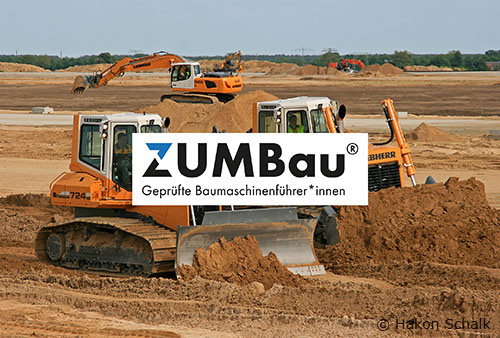
The ZUMBau qualification for "Certified Construction Machinery Operator in the Construction Industry" meets the requirements of TRBS 1116 and thus the German Ordinance on Industrial Safety and Health:
- Upon successful completion of the examination, the ZUMBau qualification leads to a nationally standardised certificate of competence with a plastic card for the safe operation of construction machinery such as excavators, cranes, or wheel loaders.
- The ZUMBau qualification is jointly supported by the leading associations of the construction industry and the German Trade Association of the Construction Industry (BG BAU)..
- BG BAU financially supports participation with an occupational safety bonus.
Corporate Responsibility as a Competitive Advantage
Every construction company should check whether the qualifications of its machine operators meet the legal requirements. Clear documentation of qualifications and training not only provides legal certainty but also increases occupational safety, efficiency, and overall operational value.
 BG BAU development programme